Table of Contents
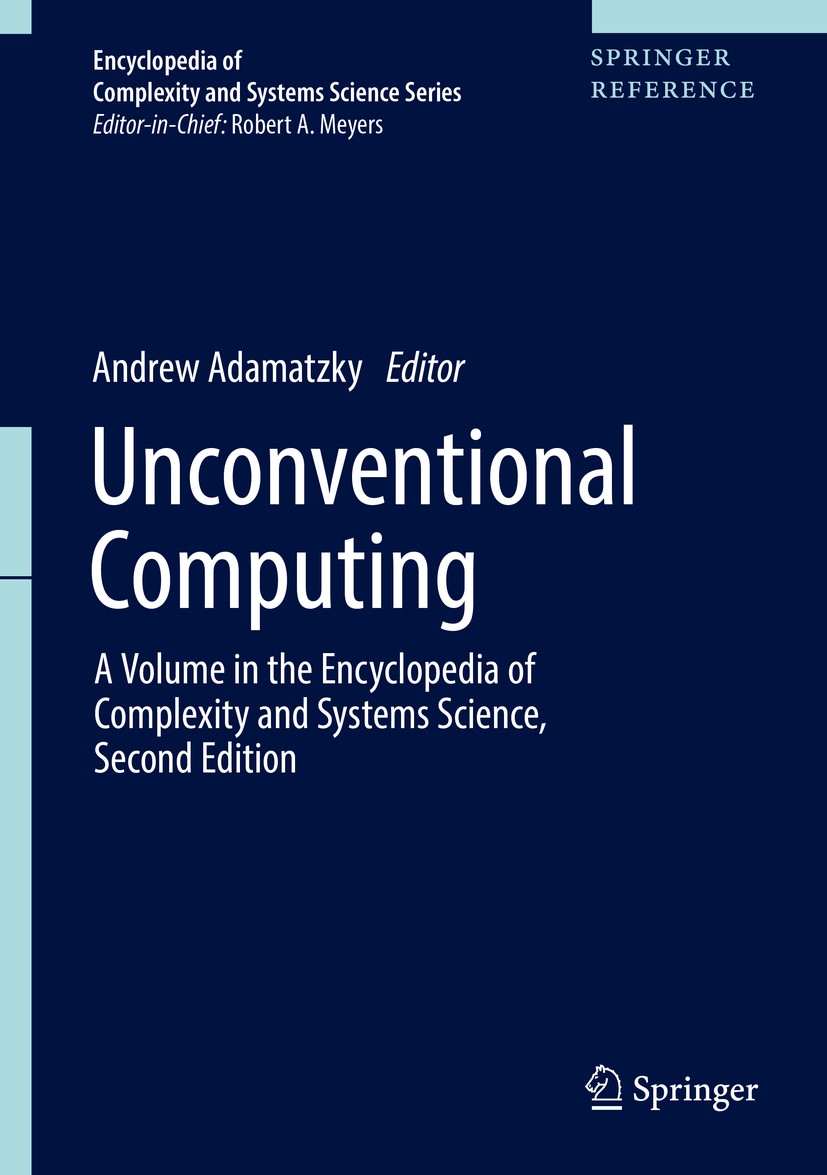
Unconventional Computing (CS492A) @KAIST in Fall 2024
 The past decades have seen an exponential growth in digital electronic computing.
But as Moore's Law approaches saturation, focus turns (back) to alternative approaches to data processing:
such as analog computing or cellular computing and also quantum computing.
The past decades have seen an exponential growth in digital electronic computing.
But as Moore's Law approaches saturation, focus turns (back) to alternative approaches to data processing:
such as analog computing or cellular computing and also quantum computing.
In this experimental course we survey and look into these and other “unconventional” computing paradigms.
Administration
Teacher: Martin Ziegler (use only this email address!)
Teaching Assistant: Abbas Mammadov (use only this email address!)
Location: online
Schedule: Thursdays+Fridays, 14h30 to 16h00 KST
Language: English only (except for students discussing in KLMS)
Prerequisites: CS204 Discrete Mathematics and CS300 Introduction to Algorithms
Preferred: additional background in (one of) Physics OR Chemistry OR Biology or CS322 or CS422
Grading: S/U. Students must get assigned and, after the Midterm, present (40~60min) one topic from the textbook 'Unconventional Computing'
Absences: 4 “spontaneous” absences, plus any reasonable pre-excused absences
Syllabus
0. Introduction
1. Conventional Computing
2. Asymptotic Computing
3. Analog Computing
4. Quantum Computing
5. Cellular Automata
6. Swarm Computing
7ff. Student presentations:
- Artificial Chemistry + Reaction-Diffusion + Membrane + P Computing (4x)
- DNA+Molecular+Bacterial+Cellular Computing (4x)
- Slime Mold Computing
- Reservoir Computing
- Amorphous Computing
- Social Algorithms
- Inductive Turing Machines (requires CS422!)
- Unconventional Problems